Taking stock of this course, I am especially proud to have been able to
participate, for more than 40 years, in a major international civil
movement, self-organized, based on free sharing and improvement of
resources and ideas, in the general human interest, without ritualization
or commercial or financial exploitation of the goodwill of anyone. In
doing so, I was able to pass on an essential public cultural heritage,
deriving no remuneration other than an ethical satisfaction from it.
And I think that all of this was in the making since my
childhood. Because from my first years of school, I was both sharer and
curious about everything, and I liked to analyze, organize, synthesize,
project.
Both during my studies and my
professional life, I was as eclectic as possible, and I did not specialize
in a particular field. I tried to accumulate as much experience and
knowledge as possible in several fields, in relation to different people,
needs, and techniques. After maturation, I wanted to pass on what I had
learned and understood, in order to give back to my society at least as
much as it had brought me, but thinking like HD Thoreau that "
How vain it is to sit down to
write when one has not stood up to live"
Indeed, life standing up brought me a lot of risks, fights, dangers,
adventures, and (obviously) knowledge, so I built myself, and I built my
life, with all that. Among my adult constructive activities, I was an
engineer and environmental expert, notably for the 6th Research
Framework-Program of the European Union, then a creator of productive
enterprises, and a leader of civil organizations. From 1998 to 2008, I
became President of an international grouping of eco-humanist NGOs,
strictly independent and non-aligned, which I represented at the UN as
part of its permanent consultative status. I have also been an organizer
and trainer for executives and facilitators of various eco-humanist
organizations in several countries.
I was then elected, from 2008 to 2009, as Chairman of the Development
Committee of the Conference of NGOs in permanent status at the United
Nations. All this in total freedom, and because my eco-humanist path
resulted from a synergy between a deep personal involvement in the reality
of my contemporary society, and an enthusiastic discovery of the perennial
roots of historical humanism.
In fact,
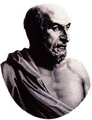 I
had felt a motivating interest in discovering that it was possible to
coordinate and extend the works of ancient Greek philosophers and those of
humanist philosophers of the European Renaissance and the Age of
Enlightenment, notably by bringing certain Vedic texts into closer contact
with them. Before that, I had also been impressed by the work of my father
Louis Carl, an ethnologist-explorer who had worked on the ancient
civilizations of the Sahara. And in 1972, Maurice Joyeux had pointed me
towards the rationalist philosophers, following articles I had published in
the newspaper Le Monde Libertaire, which he was sponsoring.
I
had felt a motivating interest in discovering that it was possible to
coordinate and extend the works of ancient Greek philosophers and those of
humanist philosophers of the European Renaissance and the Age of
Enlightenment, notably by bringing certain Vedic texts into closer contact
with them. Before that, I had also been impressed by the work of my father
Louis Carl, an ethnologist-explorer who had worked on the ancient
civilizations of the Sahara. And in 1972, Maurice Joyeux had pointed me
towards the rationalist philosophers, following articles I had published in
the newspaper Le Monde Libertaire, which he was sponsoring.
I immersed
myself with pleasure in the valorization of all this, by being particularly
interested in the historical relation of Humanity to its evolving
environment, and in the thinkers who best dealt with this subject. Little by
little, I selected and deepened some major texts, bringing them closer to
modern scientific overlaps, and all this seemed to fit together and
complement each other in a surprising way. To the point that I wanted to
bring out a synthesis as clear and exhaustive as possible, while remaining
in the trajectory of evolution and transmission which had led these
contributions up to our time. I then began to write the basics and the
template of what will be compiled to become my books "Eco-knowledge for all"
and "A great human project".
Moreover, in researching what could already exist of similar, I also
realized that talented precursors had already made this kind of approach,
but without insisting enough on the fact that an overall synthesis found
its coherence by dynamically inscribing itself in the long philosophical
tradition of a natural humanism in permanent evolution, even correction.
 And
the further I went, the more I discovered that all this was indeed part of
a natural, immanent evolutionary process, a true intrinsic project
self-generated, carried, and corrected by Humanity. This process was
underlying, but it tended to emerge better. It was only necessary to
clearly discern its insight into the future, its foresight, its
projectability, so that its content reveals all its meaning.
I tried to convince environmentalists I knew, because it
also shed new light on modern ecology. It has been difficult.
And
the further I went, the more I discovered that all this was indeed part of
a natural, immanent evolutionary process, a true intrinsic project
self-generated, carried, and corrected by Humanity. This process was
underlying, but it tended to emerge better. It was only necessary to
clearly discern its insight into the future, its foresight, its
projectability, so that its content reveals all its meaning.
I tried to convince environmentalists I knew, because it
also shed new light on modern ecology. It has been difficult.
I had supported with some of them the political campaign of the
environmentalist René Dumont in 1974, for the Presidency of the French
Republic, but it had failed, and most environmental activists of this time
were beginning to be considered by public opinion as excessive, or even
sectarian, or anti-human. It was therefore better to rely on more
sensible, more constructive values. Finally, in 1979, with a few friends
who shared these ideas, we decided, for lack of a better way, to organize
ourselves by our own means to develop structures that harmoniously combine
scientific ecology and historical humanism, with an updated philosophy of
the Grand human House (eco/oïkos) in joint development in its external
(natural) and internal (societal) environment.
Our approach
has been followed by others, since other associations and networks
promoting this innovative eco-humanism have been constituted in one
country, then in another, year after year, according to our example. I
advised and trained many animators end executives of these new structures.
On this occasion, I also realized that we needed ad-hoc synthesis books on
the philosophical, historical, and scientific foundations, and on the main
themes, of our current of thought in reactualisation. In 1998, I took back
my working notes from the 1970s, and the sheets I had written for the
first training courses of the 1980s, and this served as a core for me to
write the books "Eco-knowledges for all" and "Discourse on humanist
ecology and the philosophy of evolution", later modified to become "A
Great Human Project" in 2010.
In doing so, I have mainly worked since, in fact and in
mind, as an anthropologist.
And there, the process of permanent
self-correction, fundamental to eco-humanism, has been particularly useful
for me to gradually improve these works, and for the training of my
students and animators. On the one hand, I have corrected these books
several times, and on the other hand, it has also led me to deepen the
meaning of human evolutionary cultural programming.
 Indeed,
in the mid-1980s, in the early days of computer science on a PC (with my
Alphatronic, Amstrad, and then IBM), I had started programming a simple
application of artificial intelligence, in order to facilitate the
management of a cooperative business, by combining a database, operating
rules, and an inference and self-learning engine.
Indeed,
in the mid-1980s, in the early days of computer science on a PC (with my
Alphatronic, Amstrad, and then IBM), I had started programming a simple
application of artificial intelligence, in order to facilitate the
management of a cooperative business, by combining a database, operating
rules, and an inference and self-learning engine.
I have had not enough free time and experience in advanced
programming to technically finish this project, but I had schematized and
tested at least its logical operations. I did conceive artificial
intelligence only as a simple ersatz created by human intelligence to
usefully outsource certain tasks, and thus free up its cognitive abilities
for other non-externalizable tasks, requiring human intuition and
arbitration. But the logical design of such an artificial intelligence
could also, under certain conditions, shed light on new aspects and
drivers of our societal functioning. In this case, and although
eco-humanism cannot be reduced to or assimilated into a cybernetic system,
I had noticed that the eco-humanist cultural tool had adaptive features
that made him comparable in some respects with expert software, capable of
managing our evolutionary synergies well, provided that the knowledge
bases, operating rules, and learning and inference algorithms, remain
adequate and proactively controllable by the overall human collective
brain.
I improved my knowledge and practice of eco-humanism and
anthropology by taking this into account. And I passed the torch to others
who wanted to continue on this path, which implied the priority of the
legitimate human will and of the general interest in human development,
without preventing the use of effective designs and tools that did not
contravene such development.
Today, with all these memories
still vivid in my mind, I continue to wish courage and perseverance to all
the eco-humanists.
Let’s
continue to share and to mutualize our resources, and to help each other.
We will
feel all the more motivated and stronger to succeed.
Marc CARL
 back
back
©
www.marc-carl.net